
Why the Work Is Coming Home: What's Driving Productions Back to the US, June 2026

Updated: Jul 10
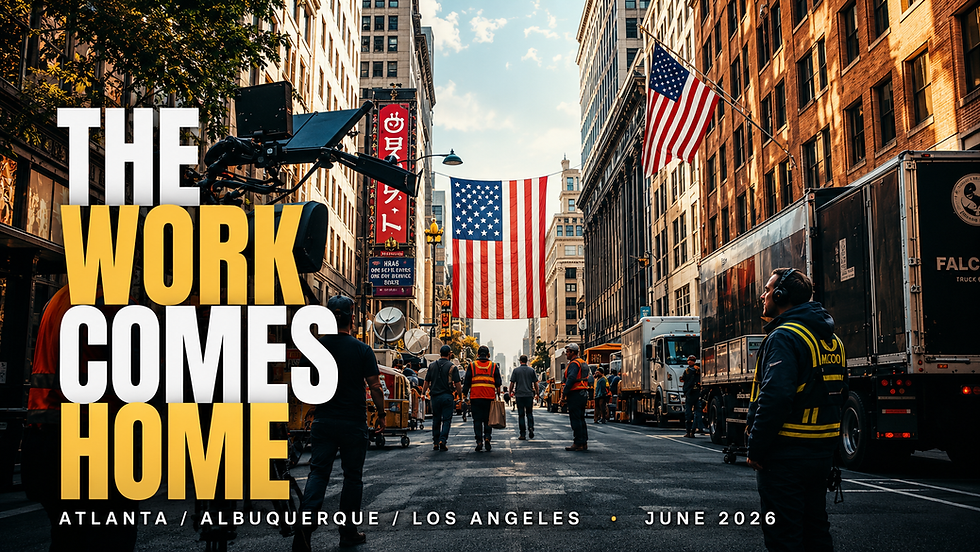
For most of the last decade, the smart money in production went looking for the biggest rebate, and a lot of that money left the country. Crews I came up with spent years chasing jobs to Vancouver, Toronto, London, and Budapest because that is where the incentives were richest. In 2026 the current has started to reverse. Productions are coming back to American soil, and it is not sentiment driving it. It is policy, economics, and a box office that finally has a pulse again. Here is what is actually happening across the three markets I work in most, and what it means from the back of the truck where the stunt team lives.
The Big Picture: Tariffs, Credits, and a Recovering Box Office
Two forces are pulling work back stateside at the same time. The first is federal pressure. The Trump administration announced plans for a 100% tariff on movies produced outside the United States, framing it as a way to claw back the filmmakers and studios that foreign rebates had drawn away, as reported by NBC News and The Hollywood Reporter. Whether that tariff lands exactly as proposed or gets reshaped, it has already changed the math in every studio's budget meeting. When a 30% foreign rebate could be wiped out by a 100% import penalty, the spreadsheet stops favoring London.
The second force is the states themselves getting aggressive. California more than doubled its Film and Television Tax Credit Program from $330 million to $750 million a year. New York raised its cap to $800 million. New Jersey now runs $800 million annually with credits up to 40%, and Netflix broke ground on a permanent studio there, according to Entertainment Partners. Texas committed $300 million on a two-year cycle. This is not a few states tinkering, it is a coordinated bet that production jobs are worth fighting for.
Underneath all of it, the audience came back. Year-to-date domestic ticket sales are running more than 20% ahead of 2025, with Gower Street Analytics projecting the domestic box office could reach $9.9 billion in 2026, the strongest year since before the pandemic. More greenlit projects plus a tariff threat plus richer domestic credits adds up to one thing for crews like mine: the work is coming home.
Atlanta: Still the Engine, Fighting to Stay There
Georgia remains the busiest production state outside California, and June backs that up. Roughly 25 projects were listed in production on the Georgia Department of Economic Development's registry this month, a mix of returning series, features, and unscripted work, as tracked by ProjectCasting. The soundstages around Atlanta are not sitting empty.
The honest part of the Atlanta story is that the boom has cooled. Direct production spending in Georgia fell from $4 billion in 2022 to roughly $2 billion in 2025, which is why the Georgia Production Partnership Alliance launched a new initiative this spring to defend the state's position, as Rough Draft Atlanta reported. Georgia's uncapped credit built the deepest crew base in the South, and that infrastructure is exactly why work returns here first when budgets reshore. From a stunt coordinator's chair, that depth is the whole game. Atlanta can crew a car rig, a high fall, and a fire burn out of local rosters without flying a single key in. When a show reshores from Canada on a compressed schedule, that ready bench is what makes Atlanta the safe call.
Albuquerque: The Clearest Bet on the Future
If you want to see what reshoring looks like in concrete and steel, look at Albuquerque. Netflix announced another expansion of its Albuquerque Studios, building on a partnership that has already produced a dozen projects locally, spent over $640 million, and employed more than 4,000 New Mexico residents since 2019, per the New Mexico Economic Development Department. That is not a company hedging its bets on a foreign rebate, that is a permanent footprint.
NBCUniversal is making the same wager. The studio committed to an Albuquerque production facility targeting $500 million in direct spending over ten years and more than 330 year-round jobs, with four sound stages projected to open in late 2026, according to the City of Albuquerque. New Mexico has 44 productions registered for the year so far. For stunt work, New Mexico has always punched above its size. The terrain does half the job for you: open desert for vehicle work, real elevation, long sightlines, and the kind of practical landscape that sells a Western or a hard action sequence without a green screen. As a stunt coordinator, I would rather rig a horse gag or a rollover on real New Mexico ground than fake it anywhere. The new stages mean the interiors can finally live in the same zip code as the exteriors.
Los Angeles: Home Court Gets Its Edge Back
Los Angeles spent years watching its own shows shoot somewhere else. That is changing because California finally answered with money. Governor Newsom's expanded program lifted the annual credit from $330 million to $750 million, and the early returns are real: 147 productions awarded, $5.5 billion in economic activity, and over 21,000 cast and crew jobs, according to the Governor's office. Shows are physically returning. The Baywatch reboot is coming back to California after the original franchise left for Hawaii, and returning series like The Pitt and I Love LA are staying put, as the Governor's office and NBC News reported.
Los Angeles was never short on talent, it was short on a reason for the accountants to keep work here. Now there is one. For a stunt coordinator, LA is still the deepest equipment and rigging pool on earth. Every specialty house, every ratchet and air ram, every veteran high-fall and fire performer is within driving distance. When a production reshores to Los Angeles, it is not just buying a tax credit, it is buying the densest concentration of stunt expertise in the world. That combination, real incentive plus unmatched crew, is why LA is climbing back.
What It Means Going Forward
The throughline across Atlanta, Albuquerque, and Los Angeles is the same. The federal tariff threat raised the cost of leaving, the states raised the reward for staying, and the audience gave studios a reason to make more in the first place. Work that drifted abroad for a decade is finding its way back to American crews who never stopped being the best at this.
I coordinate stunts across all three of these markets, and I am seeing the schedules fill in real time. If you are bringing a production home to Atlanta, Albuquerque, or Los Angeles and you need a stunt coordinator who already knows the crews, the terrain, and the safe way to put it on camera, that is the work I do. Reach me through realmccoystunts.com.


Comments